Catholic Tech Table: Introducing Our New Petrus Podcast
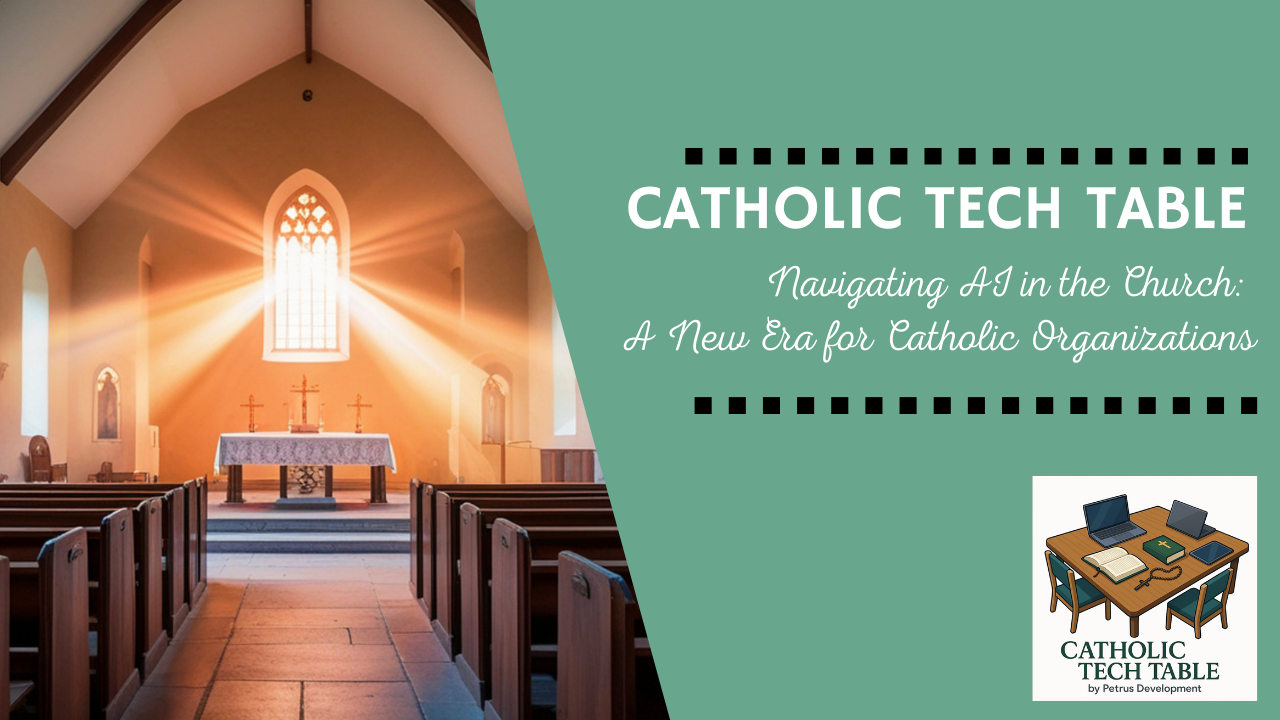
It's an exciting time at Petrus as we launch our newest podcast for Catholic fundraising professionals, Catholic Tech Table. In this introductory episode, Andrew shares an overview for this podcast's future, and he highlights how Catholic professionals can wisely navigate AI usage in their ministries.
Show Notes:
Join Andrew Robison and Rhen Hoehn from Petrus Development as they explore the transformative role of AI in the Church and in faith-based fundraising. In this episode, they discuss the necessity for Catholic organizations to be involved in AI development to create meaningful, efficient tools tailored to their needs. Key topics include the history and current landscape of AI, its applications, potential risks, and how Petrus Development is taking steps to develop AI tools specifically for Catholic fundraisers. Stay tuned for more educational content about AI, upcoming tools, and how they can serve your mission.
PODCAST TRANSCRIPT
Andrew: Howdy and welcome to our YouTube page. Today we're going to be talking about a very important topic. We're going to be talking about AI in the church and AI in fundraising. So I'm Andrew Robinson with Petrus Development. I'm excited you're here. We'll be coming to you over the next days, weeks, and months with a lot of content, a lot of information, and a lot of education about AI.
But before we start diving into all of those videos, I felt like it was important to just say: why is Petrus involved in AI? What's the landscape of AI right now? Just to get us started off on the right foot. So I've got Rhen Hane. Rhen is our director of marketing. Rhen is on this video as well. He'll be asking a couple of questions just to keep us on track. But really the point of this video is to introduce what AI is doing right now, what the potential is, and what Petrus's role is in this.
Rhen: All right. Howdy, Andrew. Excited to be here. Let's dive in. So yeah, everybody's heard a lot about AI. I think there's a lot of apprehension about it within Catholic organizations, within the church. Why should Catholic organizations be looking at using AI in their day-to-day?
Andrew: Right. So my perspective really changed after I read a book called The Empire of AI by Karen Howe. Really great read — it goes through the whole history of OpenAI, which is really the dominant player in the AI world right now. They're the ones that introduced ChatGPT, which fundamentally transformed the landscape and the user experience.
A couple of points really crystallized for me. They talk a lot about this "race to the bottom." AI has been around for a couple of decades — 30 or 40 years really — and has been implemented since the early 2000s. But the drivers of this technology are the businesses and companies that are developing it. You've got Google, Microsoft, Apple, and all of these big tech players developing AI tools. What are they developing it for? They're developing it to maximize their own profit. There are some players that are looking at how AI can serve mankind, and that's certainly there. But at the end of the day, these are all for-profit companies that have shareholders they have to deliver a return for.
So what that means is it becomes what they call a "race to the bottom." As the church and as the nonprofit community — which is what we do, faith-based fundraising — what we're going to get stuck with, if we're not part of those conversations and not part of the creation of tools, is resources that these companies develop for other groups and then repurpose for us as an afterthought. We're not going to have tools that actually serve us in meaningful ways if we're not part of the development and the thinking behind how AI can be used for good — for evangelization, for faith-based fundraising, and for funding our organizations. That's why I think we need to be involved in AI as a company, as Petrus Development, but also as faithful Catholics and nonprofit leaders.
Rhen: That makes a lot of sense. What would you say is the general attitude in the Catholic world when it comes to AI? What's the landscape there?
Andrew: Yeah. You were telling me offline that you've seen communications from bishops and church leaders that are cautioning against AI being a replacement for relationships. Is that right?
Rhen: Right. Yep.
Andrew: So I definitely think that's a risk. You've got extreme situations where people are having AI companions and replacing their therapist with AI — there are extremes to that. But the attitude of "we don't want to use this technology because of the harm it could do" is, I think, a disservice to what the technology can be used for good.
Let me give you three examples. First, think about the car. When the car was first being utilized back in the 1920s, a lot of people said, "We don't want this technology. Cars are dangerous, more people are going to die. It's going to replace the farriers, the stable workers, the people that breed and raise horses." Yet automobiles now, a hundred years later, provide us access to places we would never be able to get to and give us opportunities to build community and relationships that we never could have with horse and buggy. People were afraid of it at the beginning because of the risks, but the exploration of that technology has led to discoveries and relationships far beyond what anyone imagined.
A second technology would be the internet. When it first came around, there were a lot of cautionary tales — that the internet would replace your memory, that people were going to become intellectually lazy because they could just look everything up, and that we wouldn't meet in person because people could email and video chat. And yet the internet has brought about discoveries, connections, and tools that — while it certainly has its negative aspects — has brought so much richness, especially for Catholics and nonprofit leaders who are engaging with it in really powerful ways.
The third example I can speak to from personal experience. I worked for a guy years ago and I was the shovel man in the ditch while he operated the excavator. We dug ditches across roads and bulldozed land to build houses. For me with a shovel to dig across one road would have taken 50 guys two weeks. One man in an excavator accomplished the same thing in a fraction of the time. Yes, there is a risk of job displacement, and yet look at how much good has come from excavators and power tools — technology that maximizes our efficiency and effectiveness in ways we could never otherwise dream of.
Rhen: Yeah, and when you look at that, you can see how effective those tools are and how obvious the implementation becomes. When you look at AI, it's kind of the same thing. You can see where the tools are heading, even if they're not quite there yet, and you realize it's going to be counterproductive to keep doing things manually when you could offload those tasks to a computer. So what is the landscape of AI right now, and where do you see it heading?
Andrew: AI is used in ways you probably don't even realize. When you get on Google Maps and plan a route, it uses AI to anticipate traffic patterns and how weather might affect your commute — and it does that with far more efficiency than it used to. Netflix, Hulu, and other streaming services recommend shows based on your viewing history because AI is determining your preferences. Email spam filters, writing assistance in Google Docs — there are a lot of practical applications for AI that in no way replace relationships, but that allow us to accomplish more. Going back to the excavator analogy — AI maximizes my effectiveness and efficiency. As someone fundraising for the church or a nonprofit, it can maximize my efficiency without eliminating the ability to develop real relationships with donors.
Rhen: Great. So there are already tools out there from these big companies, but for Catholic organizations it's kind of a matter of forcing a square peg into a round hole — trying to make their tools fit our processes — unless we build tools specifically designed to fit the church's mission. What is Petrus doing going forward with AI to change that?
Andrew: We are going to be involved in the development of AI tools for Catholic fundraisers. That's the bottom line. How we do that is still evolving, but I can tell you right now that we are investing significant time, energy, and resources into understanding AI and developing tools that can be used by fundraisers, Catholic leaders, and anyone looking to do better evangelization, more efficient ministry, and more effective fundraising.
In fact — we'll talk about it in another episode — a couple of weeks ago we held our first company AI Hackathon, and it was awesome. Myself, Rhen, and two other members of the team got together and spent two days building AI agents, exploring what's possible. At the end of it, we came out with 12 solid agents — tools that can do work for you, accomplishing tasks that would otherwise take hours or days, now done in a couple of minutes.
What we're going to bring to this channel is more content and more insights into what those tools are. There will also be a lot of education about AI — the phrases, the words, the concepts that, quite frankly, I'm still learning myself. But we're going to bring you as much education as we can to make you comfortable with what AI is, what it can do, how it can be used, and what tools Petrus is developing. It's going to be fun.
We'll be doing a lot more of these videos, and we want to hear from you. What do you need? What would be most helpful in your work? Those questions will help guide the tools Petrus develops. Visit our website at petrusdevelopment.com, leave a comment on this video, or send us an email. We want this to be a community of people exploring what AI can do to make our work in Catholic, faith-based nonprofit fundraising more effective and more efficient — all for the mission of the church and for God.
So definitely follow along, subscribe, like the videos, and we can't wait to see you down the road. Thanks and God bless.
READY TO BECOME A BETTER FUNDRAISER?
Sign up below to receive tools, ideas, and inspiration to take your development efforts to the next level.
We hate SPAM. We will never sell your information, for any reason.