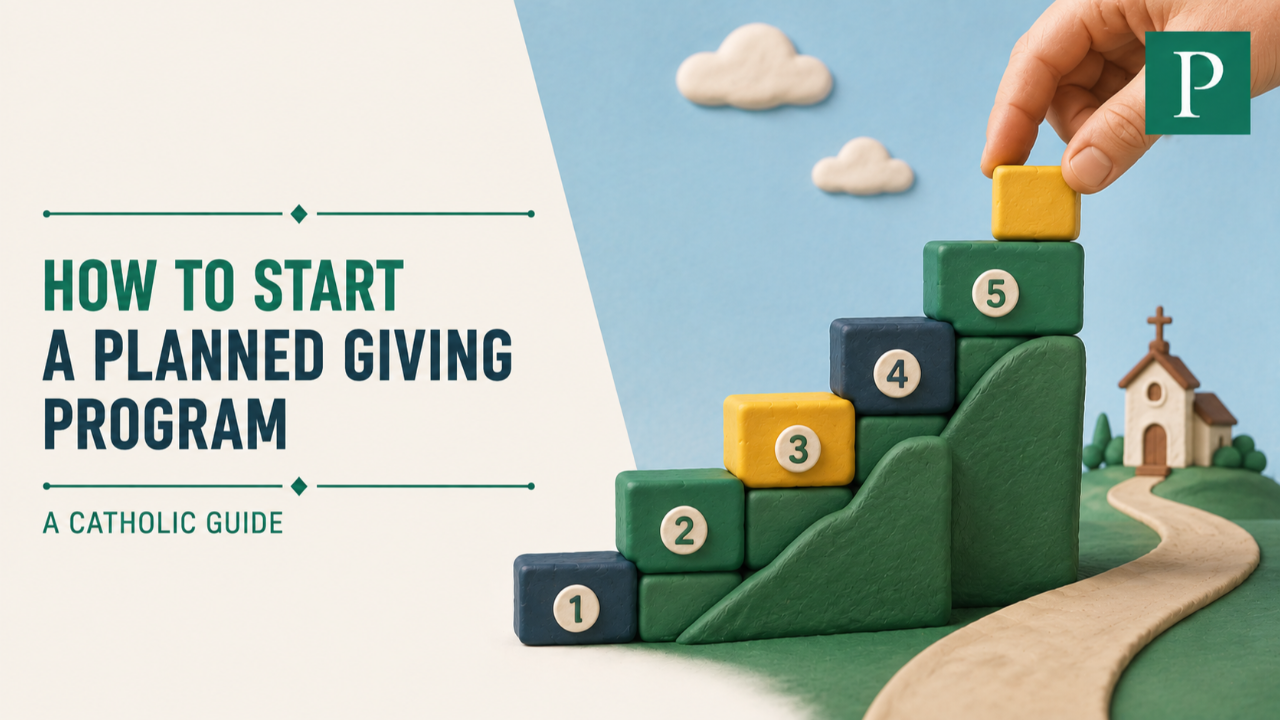
How to Start a Planned Giving Program at a Catholic Parish, School, or Diocese
By Rhen Hoehn, Director of Marketing
Someone told you it was time to start a planned giving program.
Maybe a parishioner died and left the parish an unexpected gift. Maybe the bishop asked every parish to name a planned giving contact. Or maybe you looked around and realized no one had ever invited a donor to remember the parish in a will.
So you went looking for a model. What you found were software pitches, dense legal explanations, and inspiring theology with very few practical instructions.
You do not need to become an estate-planning expert. You need a simple, responsible way to begin. This is the place to start: a four-phase, twelve-step build sequence for a development office that may be one part-time person.
On this page
- What is a planned giving program?
- What has to be true before you start?
- The Legacy Build: a four-phase, twelve-step framework
- How does this differ for a parish, diocese, school, or Catholic Charities?
- Who actually does the work?
- What is the pastor's role, and what isn't?
- How do you fit planned giving inside an existing stewardship program?
- How do you run an end-of-life planning workshop?
- What happens when the pastor is reassigned?
- How do you measure a planned giving program?
- What are the most common mistakes?
- Frequently asked questions
What is a planned giving program?
A planned giving program is the set of policies, materials, conversations, and records through which an organization invites donors to make gifts from their estate or accumulated assets, documents those intentions, and stewards those donors until the gifts mature.
For most organizations, there are many things this does not include: no gift annuity pool, no trust department, no marketing vendor, no full-time officer. Those are features of large programs, not conditions of starting one. The minimum viable program is a board-adopted policy, correct legal language a donor's attorney can use, a record of who has told you, and a fixed thank-you rhythm.
For years, most of what you receive will be bequests and beneficiary designations, by a wide margin the most common planned gifts a Catholic organization sees, so build for them first. For the full range of vehicles, see our guide to planned giving for Catholic organizations.
3 Prerequisites: What has to be true before you start?
Three organizational prerequisites gate everything else. Until all three are in place, don't market planned giving, don't launch a legacy society, and don't accept a non-cash gift.
| # | Prerequisite | Why it gates the program | Who owns it |
|---|---|---|---|
| 1 | A gift acceptance policy formally adopted by the governing board | Otherwise you decide under pressure, with a grieving family watching. A draft in a drawer doesn't count; adoption is what gives it force. | Board or finance council |
| 2 | A current IRS determination letter confirming tax-exempt status | Every donor's attorney asks for it before finalizing a bequest. Parishes and schools are often covered by a diocesan group ruling; know which document applies to you. | Business manager or diocesan finance office |
| 3 | An established relationship with counsel experienced in charitable gift planning | Real property, closely held stock, and unusual restrictions need review before acceptance, not after. "Established" means you already know who to call. | Executive leadership, often via the diocese |
The first is the one people skip, and it can cause damage. A gift acceptance policy defines which gifts you accept, which need extra review, who may approve them, and how valuation works. It also lets you decline on principle: a bequest conditioned on something contrary to Church teaching must be refused regardless of size.
Catholic organizations also face a category general nonprofit templates ignore: estates with disputed donor intent, and gifts tied to conditions incompatible with Catholic identity. The posted policies of the Catholic Foundation of Michigan and The Archdiocese of Seattleare useful models, and the IRS asks directly on Form 990 Schedule M whether a policy is in place. We cover drafting in Catholic gift acceptance policies and bequest naming.
The Legacy Build: a four-phase, twelve-step framework
Most failed programs fail on sequence, not effort: marketing before policy, or a legacy society before there's anyone to put in it. The Legacy Build orders the work so each step makes the next possible. Phases overlap; steps within a phase don't.
Phase 1: Foundation (months 1–6). Done when the policy is adopted, roles are assigned, and the pastor is equipped.
- Clear the three prerequisites, in the order above. If the policy needs drafting, that's your first quarter.
- Decide who does the work and where the fund lives: who staffs it, who holds the money, who owns the donor relationship.
- Equip the pastor or head of school with the toolkit below, before any parish-wide communication.
Phase 2: Launch (months 4–12). Done when the language is published and the first intentions are documented.
- Publish correct legal language where people can find it: full legal name, city and state, tax identification number, sample bequest wording, beneficiary-designation instructions. Most donors never call you; they hand something to their attorney.
- Fold legacy language into the stewardship calendar you already have: existing touchpoints, not new events.
- Invite existing intentions to self-identify. People have already named you in a will and never said so. Ask them to tell the office, no financial disclosure required. That's how you build a legacy society from the inside out.
Phase 3: Cultivate (year 1 onward, continuous).
- Screen for tenure, not wealth. The most reliable prospect has ten or more consecutive years of giving at any amount; planned gifts cluster among the deeply engaged at every wealth level.
- Host an end-of-life planning workshop: the highest-value recurring event a Catholic organization can run.
- Have the individual conversation with the two or three donors it already fits, using the language in how to talk to donors about planned giving.
Phase 4: Sustain (year 2 and every year after).
- Steward documented intentions on a fixed rhythm. Four touchpoints a year is our recommendation. An intention can be revocable; stewardship keeps it active.
- Measure documented intentions, not activity.
- Build for turnover. Some day your champion will leave; design so the program doesn't leave with him or her.
How does this differ for a parish, diocese, school, or Catholic Charities?
Considerably, and this is where borrowed models break. "Catholic organization" is not one thing. Four contexts, four donor bases, four different first moves.
| Parish | Diocese or foundation | Catholic school | Catholic Charities | |
|---|---|---|---|---|
| Donor base | Long-tenured parishioners at every wealth level; relationships formed through sacraments and grief | Donors who love a parish, a school, and an apostolate and want to support all three | Alumni, alumni parents, grandparents; affection tied to teachers, coaches, chaplains | Mission-motivated donors, many not identified with the institutional Church |
| Strength | Deepest relational trust; existing stewardship vocabulary | Canonical permanence, pooled investment management, acceptance expertise, counsel on retainer | An identifiable, reachable constituency with records and reunions | Concrete, vivid impact; clear tie to Catholic social teaching |
| Weakness | No staff capacity; pastor turnover; records living in one person's head | Distance from the individual relationship; perceived as "the chancery" | Little stewardship language; competing annual fund appeals | Donors may not see themselves as part of a parish or diocesan family |
| Entry framing | Stewardship as a way of life, carried to its conclusion | One vehicle for everything a donor loves in the diocese | "Your education here shaped who you are. Do that for the next student." | Legacy as continued participation in the works of mercy |
| First move | Adopt the policy; equip the pastor | Publish parish-facing tools; standardize policy diocese-wide | Add legacy language to reunion and alumni mail; screen by tenure | Name the Catholic social teaching frame explicitly |
A diocese without a foundation still captures most of the benefit by centralizing communications and adopting acceptance policy diocese-wide. A diocese with a foundation should ship parish-facing operational resources, not brochures. The Roman Catholic Foundation of St. Louis parish toolkit and the Diocese of Kansas City–St. Joseph planned giving page are worth studying.
Structural incentives matter too. The Diocese of Wichita exempts estate gifts to parishes from the standard diocesan tithe on parish revenue, removing a real disincentive for pastors. If your diocese assesses parish income, ask how bequests are treated.
Who actually does the work?
In most Catholic organizations, one person does planned giving alongside everything else. That's workable.
The solo shop. Planned giving isn't a separate portfolio of donors, it's a question you learn to ask inside conversations you're already having.
Relative to major gifts. Same donors, longer horizon. Planned giving belongs with major gifts, not annual fund operations, because it runs on visits rather than mail volume. Split them and planned giving loses; it always has the softer deadline.
Parish and foundation division of labor. Put it in writing; when it's ambiguous, donors get thanked twice or not at all.
| Function | Parish or school | Diocesan foundation |
|---|---|---|
| Identifying and cultivating the donor | Leads | Supports |
| Pastoral relationship and the ask | Leads | Not applicable |
| Acceptance review of complex assets | Not applicable | Leads |
| Holding and investing the fund | Not applicable | Leads |
| Legal and tax documentation | Not applicable | Leads |
| Recording the intention | Yes | Yes; both hold a copy |
| Thanking the donor | Yes, pastor signs | Yes, separate and coordinated |
The donor relationship belongs to the organization the donor loves; the technical work belongs to whoever has the expertise. Confuse the two and you get a chancery owning relationships it can't maintain, or a parish holding assets it can't manage.
What is the pastor's role, and what isn't?
At a parish, the pastor's personal witness is the most influential single factor in whether a legacy giving culture takes hold. The USCCB's Stewardship and Development Resource Manual calls the personal commitment of the bishop or pastor "absolutely necessary" to parish stewardship and development. Write excellent materials, convene a faithful committee, secure every diocesan resource; the culture still won't move without him.
There's a real difference between a pastor who preaches stewardship and one who makes asks, and his job is not to solicit bequests from the ambo. It's to embody stewardship thoroughly enough that legacy giving reads as a natural response rather than an institutional request. Stewardship: A Disciple's Response frames stewardship as a way of life, not a program of church support. Where that's alive, estate conversations tend to be donor-initiated.
The Pastor's Toolkit
Most pastors want to be good stewards of the parish's future and feel too stretched for another program. Remove effort; don't add it. Three items, one page each:
- A one-page theology of legacy giving, drawn from Stewardship: A Disciple's Response, that he can preach from without preparation.
- A suggested two-minute pulpit announcement, keyed to All Souls Day or the October commitment season, that still works trimmed to sixty seconds.
- A question guide for pastoral conversations: four or five open questions for when a parishioner mentions a will, an inheritance, or a spouse's death.
Hand it to him in person. Not by email. Ask for fifteen minutes to walk through it together. Emailing a pastor a PDF is functionally the same as not producing one.
One boundary: never ask a pastor to give tax or legal guidance. Parishioners with questions about wills, trusts, or beneficiary designations go to a qualified estate planning attorney.
How do you fit planned giving inside an existing stewardship program?
Legacy giving is the culmination of parish stewardship, not a program bolted onto it. When a parishioner who has given faithfully for thirty years names the parish in her will, she isn't taking an administrative step. She's making a final statement about what she loved.
So the most common parish mistake is treating planned giving as a stand-alone initiative with its own logo, brochure, society, and ask. Each signals this is something other than ordinary stewardship. Introduce it through the channels that already carry stewardship culture: homily, bulletin, witness talk, renewal weekend, annual report.
| Calendar anchor | When | Why it works | What to add |
|---|---|---|---|
| Estate Planning Awareness Month | October | A civic, practical opening that doesn't feel like an ask; often overlaps commitment season | A sidebar in commitment materials; a workshop announcement |
| All Souls Day | November 2 | Natural meditation on mortality, the communion of saints, and the Church's mission across generations | A homily mention; a bulletin insert on remembering the parish in a will |
| Parish annual report | Annual | Places legacy giving beside annual fund and volunteer recognition, where it belongs | A legacy society listing and a two-sentence invitation |
Two sentences per touchpoint is enough. Three well-placed mentions a year, repeated for five years, outperform a launch campaign, and cost nothing.
Endowment or current use?
Settle this early: does a bequest go into an endowment that spends only a portion of its return each year, or into current operations? Endowment protects permanence; current use meets present needs and is easier to explain. Most organizations need a stated default plus a documented process for exceptions; both belong in your gift acceptance policy.
How do you run an end-of-life planning workshop?
An end-of-life planning workshop is a free, parish-hosted event that helps attendees plan a Catholic funeral, name a healthcare proxy, write or update a will, and, last and briefly, consider a legacy gift. It's the most distinctive tool a Catholic organization has, because the Church offers what a bank can't: a coherent theology of death. The Catechism presents Christian death as a passage, the completion of a new birth begun at baptism (see CCC §§1680–1683). People come because the Church is a credible place for this conversation.
The four modules
| Module | Covers | Presenter |
|---|---|---|
| 1. Planning a Catholic funeral Mass | Readings, music, burial and the Church's norms on cremation, pre-planning with a funeral director familiar with Catholic rites | Priest or deacon, with a funeral director |
| 2. Healthcare proxy and advance directives | Medical power of attorney, situated in the Catholic framework of ordinary and extraordinary means | Chaplain, palliative care professional, or diocesan life issues office |
| 3. Writing or updating a will | Estate planning literacy, when an attorney is necessary, which documents to gather | Estate planning attorney |
| 4. Legacy giving as the natural extension | How a bequest or beneficiary designation works, and how to name the parish: an invitation, not a solicitation | Development officer or foundation representative |
Speaking order and roster
Order matters as much as content; it's what makes the event read as ministry rather than a funnel.
| Order | Speaker | Role |
|---|---|---|
| 1 | Pastor or chaplain | Opens. Frames the event as ministry and accompaniment |
| 2 | Priest or deacon, with funeral director | Funeral planning and Catholic rites |
| 3 | Chaplain or palliative care professional | Advance directives and Catholic medical ethics |
| 4 | Estate planning attorney | Wills and documents. Introduce as an independent professional, not your organization's advisor |
| 5 | Development officer | Last and brief. Legacy giving as invitation |
| 6 | Pastor or chaplain | Closes. Prayer, and the pastoral frame restated |
Logistics and follow-up
- Cap attendance at thirty to fifty. Larger rooms suppress the questions that make the event worth holding.
- Plan four to six weeks out, anchored to October or All Souls Day.
- Co-host with the diocesan foundation; they already know the attorneys and funeral directors.
- Market it as a service: take care of your family and honor your faith, never as a fundraiser.
- Collect contact information at registration, noting anyone who indicates interest in legacy giving.
Attending is an act of vulnerability; people in that room are acknowledging mortality. Follow-up must honor that.
- A thank-you note from the pastor within two weeks. Signed, not stamped.
- A resource packet with local attorney referrals, will-preparation guidance, and a one-page summary of legacy giving options.
- An invitation to a legacy society reception six to eight weeks later, for those who indicated interest at registration.
- Not a direct solicitation call. Not at week two, not at week eight. The event's credibility rests on this.
For a working model, look at the Circle-of-Life Seminars run by The Catholic Foundation in Dallas: free, rotating among parishes, co-presented by clergy, medical professionals, funeral directors, and development staff, with follow-up built around education rather than solicitation.
What happens when the pastor is reassigned?
This is the defining failure of Catholic planned giving,. A pastor champions the program for four years, then is reassigned. His successor has different priorities, inherits no records, and hears nothing from staff. Within eighteen months the program is gone, along with the intentions nobody documented. Planned giving matures over seven to fifteen years; pastoral assignments are shorter.
Five things make a program survivable:
- A committee, not a champion. A committee of three to five people, ideally including a retired attorney, accountant, or financial professional, carries memory across pastorates, and gives an incoming pastor a group to be briefed by rather than a project to inherit.
- Written policy adopted by a governing body. A board-adopted gift acceptance policy is the most durable artifact you'll create. Policies survive personnel; practices don't.
- Records that live with the organization. Documented intentions belong in the donor database with a designated field, plus a paper file in the office, not in a staff member's inbox or memory. If you left tomorrow, could your successor produce the list?
- A written program summary for the transition file. Two pages: what the program is, who's on the committee, where the records are, the calendar anchors, and who has documented intentions. Hand it over in the first month, in person.
- Diocesan-level continuity. Where a foundation holds funds and keeps parallel records, a parish program can survive a transition nearly intact, the strongest argument for the foundation relationship.
How do you measure a planned giving program?
With leading indicators, on a multi-year horizon, and never with a realized-dollar goal in the first several years. Get this wrong and the program is defunded before it could possibly have worked.
Documented gift intentions per year is your primary metric. It's a leading indicator: countable, reportable this fiscal year, and predictive of future revenue. Realized dollars are the lagging indicator: they are real, but they measure cultivation that happened long before you arrived.
The distinction that kills programs is activity versus outcome. Reporting activity as outcome destroys credibility exactly when you need it.
| Metric type | Examples | What it tells you | Report it as |
|---|---|---|---|
| Activity | Visits made, workshops held, mailings sent, bulletin mentions | Whether the work is happening; diagnostic when results lag | Effort, never achievement |
| Leading outcome | Documented intentions added this year; legacy society members; qualified prospects identified | Whether the work is producing commitments | Your headline number |
| Lagging outcome | Realized bequest dollars; estates settled | Whether old commitments are maturing | A multi-year rolling total, not an annual goal |
Three honest expectations for a parish with a half-time development director:
- Year one produces almost no documented intentions. You're drafting policy and building a toolkit; that is the correct output.
- Years two and three produce intentions in the low single digits annually. A functioning small-shop program, not a failure. Judge the trend, not the count.
- Realized dollars arrive seven to fifteen years out, unevenly. One estate can exceed a decade of annual fund growth; the next five years can be quiet. Never budget against a specific expected gift.
Frame the ratio, not the total: a fraction of one staff person's time and some printing, against gifts that are typically the largest an individual will ever make. A projection you can't support will be used against you. See setting fundraising goals and the top five metrics.
Small organizations can absolutely do this. The Diocese of Wichita's Grateful Steward Legacy Society, established in 2023, sets no minimum gift and recognizes members with a monthly Mass intention offered by the bishop and an annual appreciation evening, available to any parish with a policy and a list.
What are the most common mistakes?
- Marketing before policy. Promote legacy giving without a board-adopted gift acceptance policy and your first complex gift becomes an emergency.
- Setting a dollar goal in year one. You'll miss it, because the gifts mature in a decade. Set an intentions goal instead.
- Depending on one champion, whether pastor, principal, or you. Build the committee and the records before you build momentum.
- Screening for wealth instead of tenure. Your best prospect may give a modest amount monthly and have done so for twenty years.
- Emailing the Pastor's Toolkit. Fifteen minutes in person, or don't bother making it.
- Soliciting workshop attendees. A call asking for a gift after an end-of-life planning event will be remembered, and not the way you want.
- Leaving intentions undocumented. An unrecorded intention is one staff departure from not existing, and the donor loses the stewardship that keeps a revocable gift in place.
- Waiting for a finished program to start a conversation. The two or three donors a legacy conversation already fits are on your list right now.
Frequently asked questions
How long does it take to start a planned giving program at a parish?
Six months to a working foundation if the gift acceptance policy must be drafted and adopted, less if one exists. Documented intentions usually begin in year one or two; realized gifts arrive seven to fifteen years out. The program is real long before the money is.
Can a small parish or school do planned giving without dedicated staff?
Yes. Bequests and beneficiary designations need no minimum gift, no annuity pool, and no software, just a policy, correct legal language, a record of who has told you, and a fixed stewardship rhythm. A protected half day a week is enough to start.
What does a planned giving program cost?
Mostly staff time rather than cash. Direct costs are modest: printing, a workshop, occasional legal review. The real cost is a protected share of one person's time. Present that tradeoff to leadership rather than a projected return you can't support.
Who should serve on a parish planned giving committee?
Three to five people: ideally a retired estate planning attorney, accountant, or financial professional; one or two long-tenured parishioners respected across the community; and a staff member for continuity.
Should the pastor ask for planned gifts from the pulpit?
No. His role is witness, teaching, and pastoral conversation. Soliciting from the ambo compromises the pastoral relationship and works less well than witness. A pastor who says in his own words that he has made provision for a mission he loves accomplishes more than any brochure.
How is planned giving at a Catholic school different from a parish?
The school has an alumni base a parish doesn't, with records and reunions already in place. What it lacks is stewardship vocabulary, so the entry point is institutional identity rather than theology: your education here shaped who you are, and you can do that for the next student.
Should a bequest go to the parish or the diocesan foundation?
Usually the foundation holds and invests it while the parish or school owns the donor relationship and the ask. Ask two things first: how the diocese treats bequests if it assesses parish revenue, and whether the foundation keeps records that survive a pastoral transition.
This article is written for fundraising professionals and does not constitute legal or tax advice. Donors considering any planned gift involving estate documents, trust agreements, or beneficiary designations should consult a qualified estate planning attorney. Organizations should consult their own counsel and their diocesan development office before accepting complex gifts.
READY TO BECOME A BETTER FUNDRAISER?
Sign up below to receive tools, ideas, and inspiration to take your development efforts to the next level.
We hate SPAM. We will never sell your information, for any reason.